
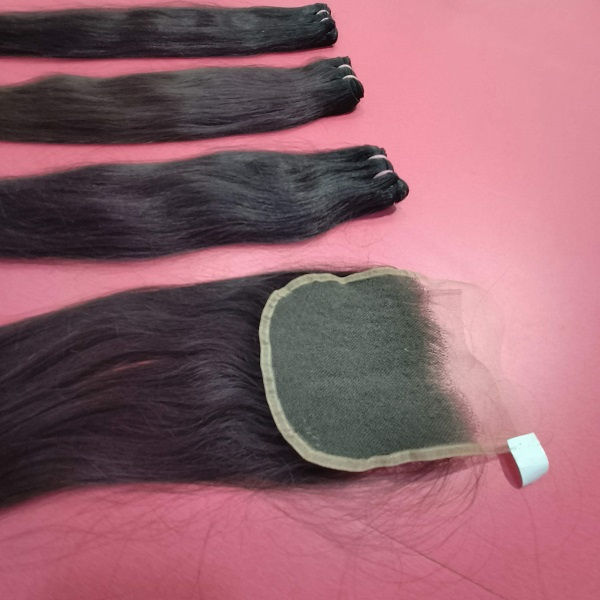
100% human hair bundles with closure

Updated: Sep 1
A sew-in or wig built from bundles alone always runs into the same problem: what to do at the crown. Leaving your own hair out means daily blending and heat damage; covering it badly means an obvious, wiggy finish. Bundle-with-closure sets solve this neatly, which is why they have become the default way stylists and wig makers order 100% human hair. Here is how the pieces work together and how to buy a set that installs seamlessly.
What a Closure Actually Does
A closure is a small panel of lace — most commonly 4x4 or 5x5 inches — with individual strands hand-knotted into it to mimic a scalp and a natural parting. It sits at the top of the head and 'closes' the install, so none of the wearer's own hair needs to be left out. Compared with a frontal, which spans ear to ear, a closure covers less area, costs less, needs less customisation, and holds up better for everyday wear.
How Many Bundles Complete the Set
The answer depends on length and desired fullness. As a working rule for a full head with a 4x4 closure:
Lengths up to 16 inches: two bundles are usually enough for a natural density
18 to 22 inches: three bundles, since longer wefts carry less hair per gram of length
24 inches and above: four bundles for anything more than a sleek, flat style
Voluminous curly installs: add one bundle over the straight-hair rule, because curls shorten the visible length
Getting a Seamless Match
The set only looks like one head of hair if every piece came from compatible raw material. Order the closure and bundles from the same supplier and the same texture line, ideally cut from similar donor hair. Check that the closure's lace tone suits the wearer's skin or can be tinted, that knots are small enough to pass as pores after light bleaching, and that the parting space is genuinely free-parted rather than locked into one position. A mismatched closure ruins otherwise excellent bundles, so never treat it as an afterthought.
Caring for Bundles and Closure Together
Wash the full install as one unit with diluted shampoo, working downward in the direction of the cuticle, and condition the lengths while keeping heavy product away from the lace knots. Blot rather than rub the closure area, since friction loosens knots over time. Between installs, store the closure flat with the lace supported so it keeps its shape. Looked after this way, a quality human hair set survives several reinstalls, and the closure — usually the first piece to fail on cheap sets — lasts as long as the bundles it crowns.

Comments